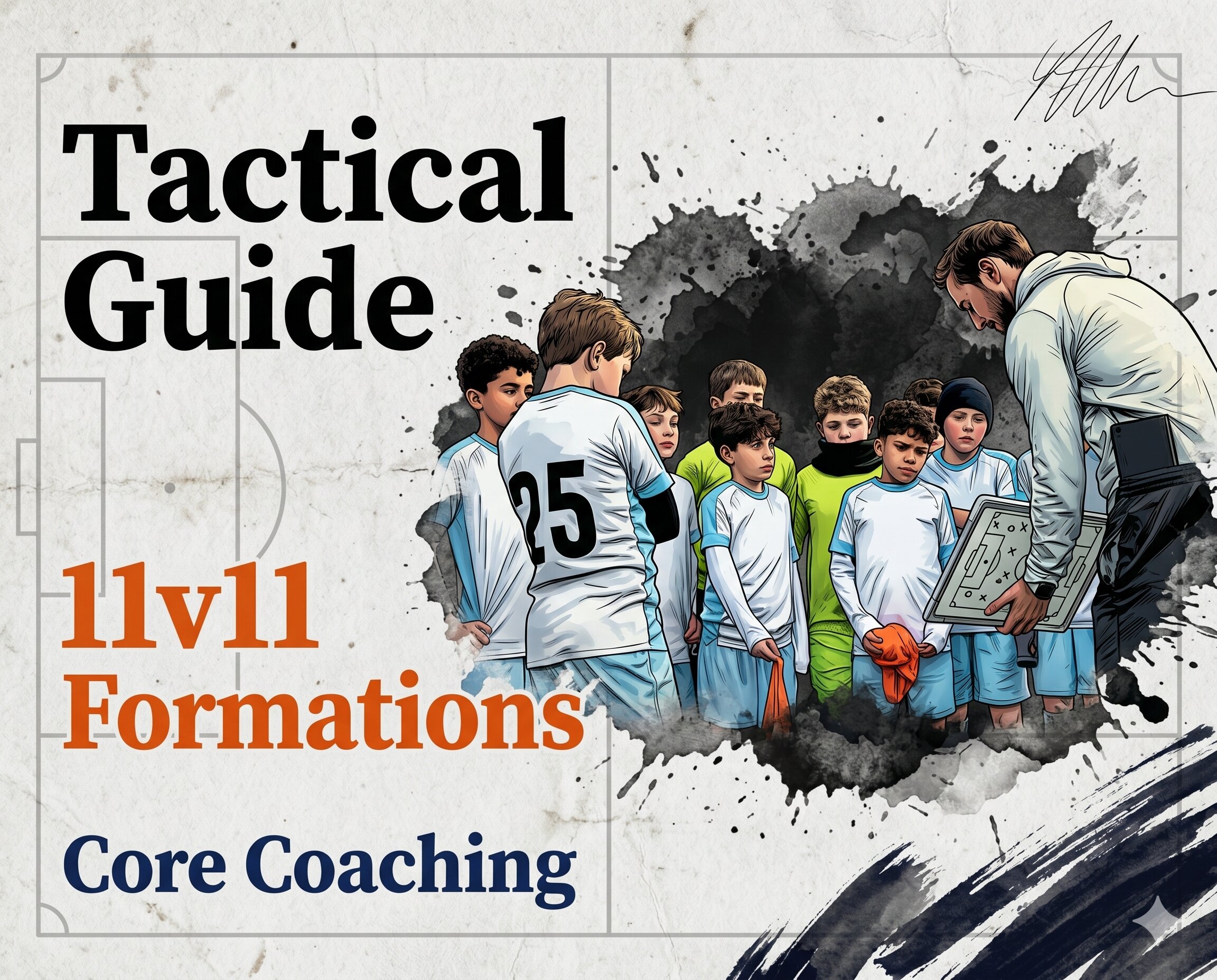
It's the 52nd minute. Your team is chasing the game. You set up in a 4-3-3 because that's what you believe in — high press, positional play, the whole thing. But your left center-back is a converted midfielder who's never defended a back three in his life. Your two eights don't have the engine for the vertical press. And your wide forwards? They're tracking back. Both of them. Every time.
You're watching a 4-5-1 defend for its life. That's not the team you built in your head. That's the team you actually have.
This is the conversation nobody wants to have about 11v11 formations. Not which system is most sophisticated, or which Premier League manager runs the most elegant structure. The real question — the one that determines whether Saturday goes well or falls apart — is simpler and harder: does your team have the personnel, the training volume, and the tactical maturity to actually run this system when the game gets hard?
11v11 is the first format with genuine positional complexity. Real wide channels. Functional double pivots. Defensive lines that must hold their shape under pressure. Specialized roles that demand specific physical and technical profiles. The coaches who build durable, competitive teams at this format are the ones who choose formations that fit — and who know the difference between aspiration and honest assessment.
What a Formation Actually Is (and Isn't)
A formation is a positional reference. A starting shape that signals responsibility. It tells your players where they tend to operate and where their teammates expect them to be — but a formation is not a script. The best teams renegotiate their shape constantly: a 4-3-3 defends as a 4-4-2, builds as a 3-2-5, and presses as a 4-2-4. The number on the lineup card is just the beginning of the conversation.
What that means practically: when you choose a formation, you're not choosing a picture. You're choosing a set of structural demands, a pressing logic, and a set of role profiles that your players either match — or don't. Before you draw anything on a whiteboard, answer three questions honestly.
Who are your players? Not who you wish they were. Who do you actually have, right now, in this squad? Which players can function in high-responsibility roles under pressure? Which can't?
What's your coaching bandwidth? Some systems run on rails once the players understand them. Others require constant in-game management — reading the shape, communicating adjustments, making substitutions that change the structure mid-game. Be honest about how much of that you can actually do on a Saturday touchline.
What does your team need developmentally right now? This is the question grassroots and academy coaches most often skip. What would look impressive on the scoreboard this season versus what would actually develop these players over the next three years — those are sometimes different answers.
A formation only makes complete sense when you consider all four moments of football: in possession, out of possession, attacking transition, and defensive transition. Your 4-3-3 in possession might become a 4-5-1 out of possession; your 3-5-2 might become a 5-3-2 when the ball is lost. The best formation for your team is the one that transitions coherently across all four moments — not just the one that looks right in your attacking phase.
The Major Systems — What They Actually Demand
4-3-3
The 4-3-3 is the archetypal pressing formation. Three forwards create natural traps against back lines. The midfield triangle — depending on orientation — either protects or attacks. In and out of possession, it demands full-backs who can push high, wingers disciplined enough to track back, and eights with the engine to cover vertical distance repeatedly.
What it gives you: Constant pressure in the opponent's half when it works. The three forwards create natural pressing traps against back fours, and the shape supports quick attacking transitions — win the ball high and you're already in a 3v4 against a recovering defense. The wide forwards operating as inverted runners or touchline pins give you genuine width without a specialist winger role.
What punishes you when you're not ready: The wide channels. When your full-backs join the attack and your wingers don't track, you're defending a 2v2 in wide areas. It happens constantly against coaches who know what they're looking at. The 4-3-3 that doesn't press becomes a 4-5-1 with the strikers already exhausted — you've taken on all the defensive liabilities of a 4-5-1 without the structural compactness that makes a 4-5-1 work.
The pressing demand is the non-negotiable. Effective pressing requires compactness, cover shadows, collective recognition of the trigger, and the correct orientation of the first presser — all six demands running simultaneously. If your players are waiting for your instruction on the touchline rather than reading the trigger together, your press will always arrive a beat late. That's not a fitness problem. It's a trust and recognition problem, and the 4-3-3 exposes it mercilessly.
The forward press role is a specialist position. Your wide forwards need to understand exactly when and where to initiate — press the wrong shoulder on a back pass and you've opened the channel instead of closing it.
Best for: Pressers and Architects with a high-energy squad and enough training time to build the pressing triggers collectively. The system rewards weeks of deliberate trigger work. Without it, it costs you.
4-2-3-1
The 4-2-3-1 offers structural stability through its double pivot and a #10 who operates freely in the half-space between the lines. It's a controlled system — built for teams that want to dominate the middle third without committing heavily to a high press.
What it gives you: The double pivot is the system's backbone. Two holding midfielders protect the back four, cover the channels, and recycle possession under pressure. That security allows your wide players and #10 to take risks higher up the pitch. In possession, the shape creates natural triangles across the midfield third — the #6 feeds the #8, the #8 combines with the #10, the #10 links to the striker. When it flows, it's the most controllable possession structure available at 11v11.
What punishes you when you're not ready: The #10 is the formation's creative hinge, and your entire attacking structure depends on that player finding space between the lines. When an organized opponent marks the #10 tightly — or when your #10 doesn't understand the role and drifts wide or deep — the shape becomes passive and predictable. Your double pivot then has no outlet between the lines, and you end up playing slow, lateral possession with no penetration. The 4-2-3-1 without a functioning #10 is a 4-2-4 that never threatens the final third.
Wide player profile matters more than coaches expect. Your wide players in the #7 and #11 positions need to make a clear decision: inverted runners who cut inside and shoot, or orthodox wingers who hug the touchline and cross. Mixed signals here create spacing problems across the whole attacking line — the striker doesn't know where to make runs, and the #10 doesn't know where to find space.
Best for: Architects who prioritize positional control and have a genuine playmaker at #10. Also suits coaches who want structural clarity for younger players learning their roles, because the double pivot creates a forgiving defensive structure that covers individual errors.
3-5-2
The 3-5-2 is one of the most demanding systems to run well and one of the most beautiful when you do. Width comes entirely from the wing-backs, who function as both full-backs and wide midfielders — effectively covering the whole touchline across 90 minutes. The back three provides defensive solidity and allows one center-back to step into midfield in possession. The double striker partnership creates constant reference points.
What it gives you: A back-three build-up structure that is tactically rich and difficult to press. When your center-backs are comfortable in possession, you can use asymmetric build-up patterns — one center-back steps into the midfield line while the opposite wing-back pushes high, creating a 3-2-5 in possession that overloads any team trying to press man-to-man. The double striker partnership is constantly available as a pressing outlet, and in defensive transition, the five-man defensive line (the 3-5-2 that becomes a 5-3-2) is extraordinarily difficult to play through quickly.
What punishes you immediately: Wing-backs who can't get forward. The moment your wing-backs sit deep because they're nervous about the defensive commitment, you lose all width. Your shape becomes a 5-3-2 — compact, yes, but narrow and passive. You've bought defensive stability at the cost of everything that makes the system work. Against a team with genuine wide players, you'll spend the whole game defending wide combinations from a congested central block.
The striker partnership is an underrated demand. Two strikers who don't understand how to press together, hold together, and combine in tight spaces will have the ball bouncing off them all game. The 3-5-2 requires a striker relationship — not just two strikers.
Requires: Two genuine wing-backs (athletic, technically reliable, and tactically mature). If you don't have them, you don't have a 3-5-2 — you have a 5-3-2 with wing-backs who are too tired to defend by the 70th minute.
Best for: Builders who want to control territory through physical dominance and coaches who have two real wing-back profiles in their squad.
4-4-2
The 4-4-2 is the most honest formation in football. Compact. Collective. Physically demanding. Its horizontal defensive structure is hard to play through centrally, and it punishes opponents who try to build through the middle under pressure.
What it gives you: Two banks of four that are genuinely difficult to break down when they're organized. The structure creates clear responsibilities — every player knows their defensive shape and their transition trigger. In attack, two strikers offer constant pressing reference points and a reliable target for direct play. The 4-4-2 is the format most forgiving of individual errors, because the shape covers mistakes with structure rather than individual quality.
The pressing dimension: The 4-4-2 presses with its strikers first — the two forwards apply pressure on the ball while the midfield four hold their shape behind them. When that works, the midfield four intercept second balls and win duels in the central third. The whole structure depends on two strikers who press with intelligence, not just effort. Two strikers who chase the ball without a plan mean your midfield four are defending a 3v4 centrally within the first five minutes, and the system unravels from the front backward.
What punishes you when you're not ready: The space between your midfield four and your back four. A technically confident opponent will find the two central midfielders' gaps — particularly the space just behind a #10 who drops between the lines. The 4-4-2 demands midfielders who can read that threat and step aggressively to win it, rather than dropping into the defensive line and creating a 6v2 behind the ball.
Best for: Pressers who want a direct, intense style. Also a legitimately strong choice for coaches managing squads without a clear #10 profile — the 4-4-2 doesn't require one.
4-4-2 Diamond
The diamond creates central overloads and gives a #10 a specific operating zone between the lines. The #6 at the base of the diamond is a specialist — positionally demanding, required to cover ground and read the game at the same time.
What it gives you: Central dominance. Your #10 operates in the space that most formations struggle to mark cleanly — behind the opponent's midfield line, ahead of their back four. A genuine #10 in that zone will get the ball in tight spaces and create chances consistently. The diamond also creates natural pressing traps centrally — the #10, two eights, and #6 can compress an opponent's double pivot and win the ball high up the pitch when the shape is right.
What punishes you when you're not ready: Flanks. Wide areas are exposed by design, covered only when your wide midfielders track back aggressively and your full-backs know when to push. If your opponent figures this out before halftime — and any organized coach will — they'll isolate your full-backs in 1v1 situations wide and exploit the space all game. In-game, the diamond demands constant monitoring of your width exposure and active adjustment when the flanks open.
The #6 is the system's least visible, most critical player. Without a disciplined holding midfielder reading the game and covering the channel balls, every wide attack becomes a direct route to goal. This is not a role you can fill with a technically limited player who runs hard. It requires genuine tactical intelligence under pressure.
Best for: Architects with a genuine #10 and a disciplined #6. High coaching complexity — the system needs active in-game management across both flanks to stay functional.
The Pressing Dimension
Formation sets the default. Pressing decisions determine whether the shape creates problems for the opponent or just describes where your players start.
The pressing trigger is the most coaching-impactful variable in any pressing system. A trigger is the cue that initiates collective pressing — a poor touch, a back pass, a goalkeeper in possession. If your players wait for your instruction rather than reading the trigger collectively, your press will always be a beat late. That's the real pressing problem most coaches face. Not fitness. Not desire. The inability to recognize the moment together.
High pressing — the kind that defines 4-3-3 and similar structures — demands structural bravery. You commit numbers forward and accept the space behind your defensive line. If your team isn't ready for that commitment, the mid-block-to-high-press transition gives you a genuine alternative: invite the opponent to build, absorb pressure in a compact shape, then spring into an aggressive press at the moment of their committed pass. The discipline to hold the shape before springing — to look passive while being anything but — is sophisticated in-game leadership. Most coaches panic and press too early.
If your squad's aerobic capacity or tactical maturity rules out sustained pressing, a bunker-and-counter structure is a legitimate tactical choice, not a failure of ambition. Know what your team can sustain for 80 minutes — not just the first 20.
Your Practical Evaluation Framework
Before you choose a system for this season, run through this honestly.
Assess your personnel. List your most tactically reliable players. Where do they play? Which positions are thin? Map your quality distribution honestly — if you have three strong central midfielders and two reliable center-backs but limited wide players, a 4-3-3 will expose your flanks and starve your midfield of the ball it needs. A 3-5-2 or 4-1-4-1 might serve you better. A 3-5-2 with one natural wing-back is a 5-3-2. A 4-3-3 without pressing eights is a 4-5-1. Build from what you actually have.
Assess your coaching bandwidth. Some systems — the 4-2-3-1, the 4-4-2 — run on structural clarity once the players understand their roles. Others — the diamond, the 3-5-2 — require active in-game management to stay functional. How much of that can you do on a Saturday? How much of that do you want to do?
Assess your developmental priorities. What do your players need to grow right now? At youth stages, the priority is exposure to multiple positions and decision-making in transitions — not tactical optimization. Sometimes the right system is the one that creates the most opportunities for the decisions your players need to make, not the one that looks most sophisticated on a formation card.
Assess what the system demands under pressure. Every formation has a failure mode — what it looks like when it breaks. Know yours before the first game, not during it. The 4-3-3 becomes a 4-5-1. The 3-5-2 becomes a narrow 5-3-2. The diamond exposes both flanks simultaneously. When you know the failure mode, you can train for it — and manage it from the touchline when it appears on Saturday.
Assess whether you can train it in game-proximate activities. A formation you understand conceptually but can't build in your sessions is a formation you don't really own. If you can't design activities that create the decisions your system demands — the pressing trigger recognition, the wing-back's forward-and-back cycle, the #10's movement between lines — your players won't be able to execute those decisions under match pressure.
Formation Is an Identity Question
The coaches who build durable, competitive systems — at U14, at college level, at any level — have one thing in common. They're honest about who they are.
Remember the 52nd minute from the opening of this piece — the 4-3-3 that became a 4-5-1 under pressure. That coach isn't a bad tactician. He might be a brilliant one. But he built a system around who he wanted to be rather than who he was, and who his team was, right then. The gap between those two things is where systems collapse.
Your coaching identity — the values, the beliefs, the way you see the game — should drive your formation choice. But that identity has to be in honest conversation with your actual context: your players, your training time, your developmental stage. The best version of your 4-3-3 is not someone else's. It's yours. Built for your players, taught in your sessions, managed with your read of the game.
That's the formation worth building.