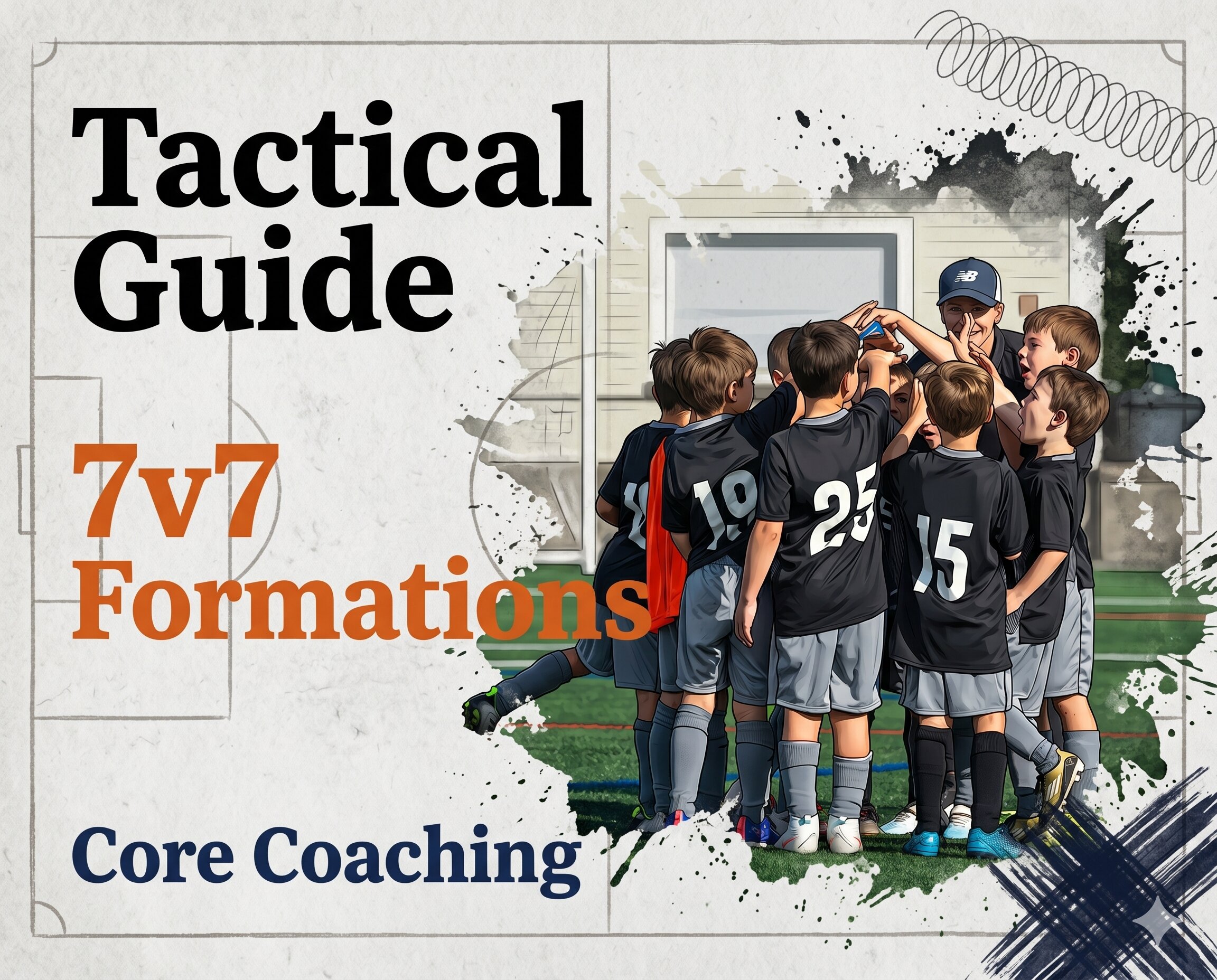
You've spent twenty minutes on it. Cones, pinnies, walking through positions. Your U9s know exactly where they're supposed to stand at kickoff. And then the whistle blows.
Within thirty seconds, it's a swarm. Six kids within ten yards of the ball, your goalkeeper wandering into midfield, and your most creative player — the one who never stops moving — frozen on the touchline because you told her to stay wide.
You've organized them. And somehow the game got worse.
Here's the thing about 7v7 formations that nobody says out loud: the best ones are barely felt. They're a starting reference, not a system to enforce. But that doesn't mean formation is irrelevant at this age — it means you have to understand what each shape is actually for before you can use it well. The right formation, used the right way, puts your players in situations that develop ball mastery, sharpen 1v1 instincts, and build a genuine feel for space. The wrong formation — or the right one taught badly — just creates positional anxiety.
What 7v7 Is Actually Built To Do
In most US youth pathways, 7v7 is where your players meet a goalkeeper for the first time. The field opens up. The social geography of the game gets more complex. There are more teammates to trust, more decisions per minute, and real space to exploit — or get lost in.
That's intentional. 7v7 isn't a scaled-down 11v11. It's a purposefully designed developmental habitat. The pitch dimensions, the number of players, the frequency of 1v1 and 2v1 situations — all of it is calibrated to a developmental frequency that a full-sided game would completely overwhelm.
At this age, your players are in the middle of a transition that takes years to complete: from "me and the ball" toward "us and the game." They're starting to notice teammates. Starting to understand that winning the ball together is even better than winning it alone. Formation conversations only make sense inside that frame — which means every shape you choose should serve three priorities: more 1v1 moments, more ball-mastery opportunities, and a growing feel for how space works.
Because the game itself is the primary teacher at this stage. Small-sided formats are designed to create a cascade of perception-action moments: a player sees space, makes a decision, lives with the consequence, adjusts. That cycle — uninterrupted — is where development actually lives.
The Three Shapes Worth Knowing — And Why Each One Works
You're here because you searched for 7v7 formations, and that's a fair question. Here's an honest answer — not just what the shapes look like, but what each one does developmentally and where it earns its place.
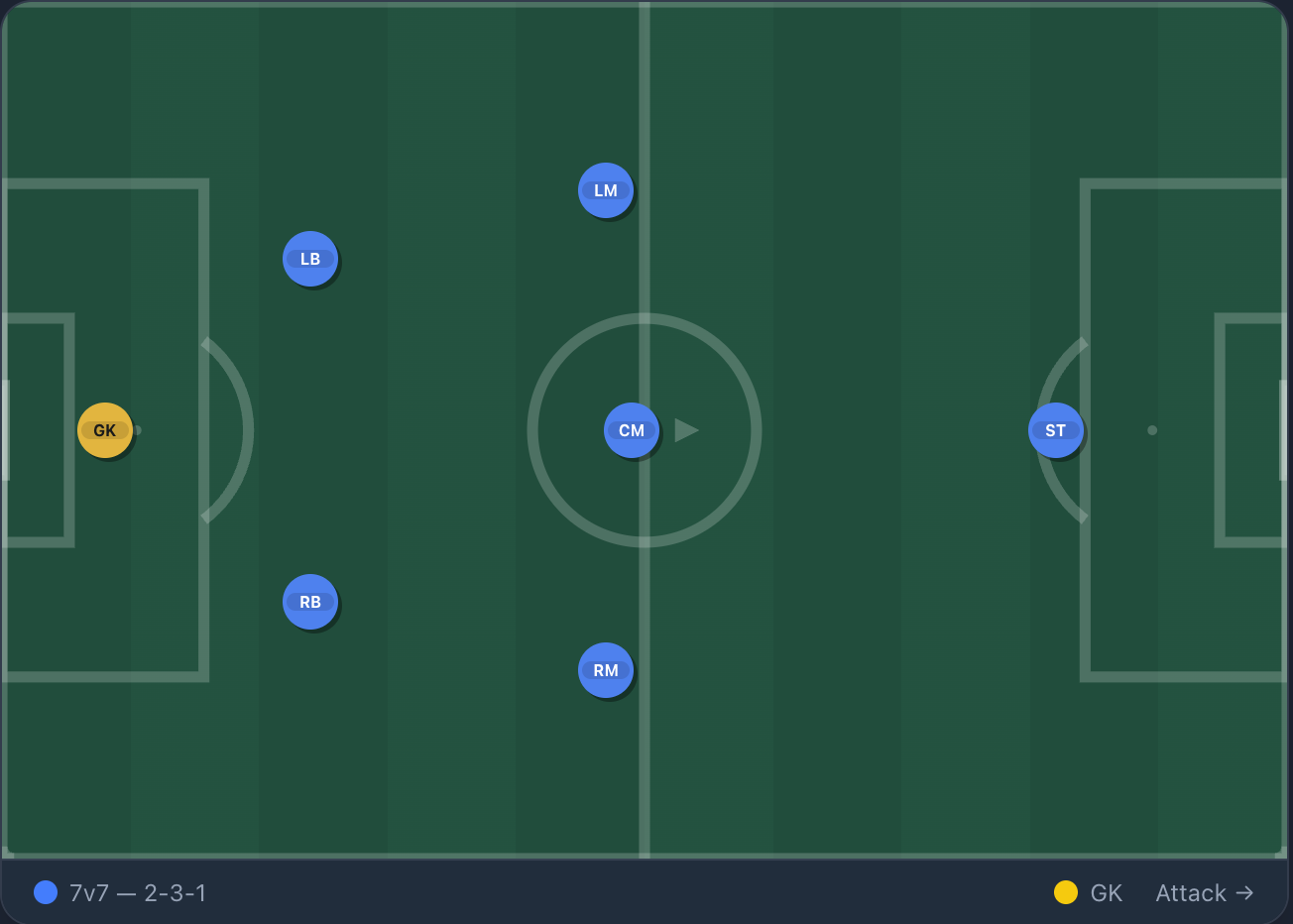
2-3-1: The Learning Shape
2-3-1 is probably the most common shape at this level, and for good reason. Two defenders give your goalkeeper a sense of protection and establish a clear first line. Three midfielders create the densest coverage of the middle third — which at this age is where the vast majority of 1v1 and 2v1 situations occur. A lone forward gives you a target in transition.
What this shape does for development: the three-midfielder band is a 1v1 laboratory. Your central mid gets pressed constantly — she has to use her body, turn under pressure, and find an outlet. The wide midfielders are in perpetual 1v1 battles for the flanks. Every time the ball arrives at their feet, there's a real decision: take on the defender, combine with the nine, or recycle. Those decisions, repeated across fifty minutes, are where ball mastery and 1v1 confidence actually build.
The 2-3-1 also distributes players across the pitch in a way that naturally discourages the swarm — not because anyone is being held in a lane, but because the shape creates genuine spatial separation. Players are far enough apart that they have to pass to connect. That distance is the learning. If your players have any frame of reference for "where do I go," this gives it to them without demanding much.
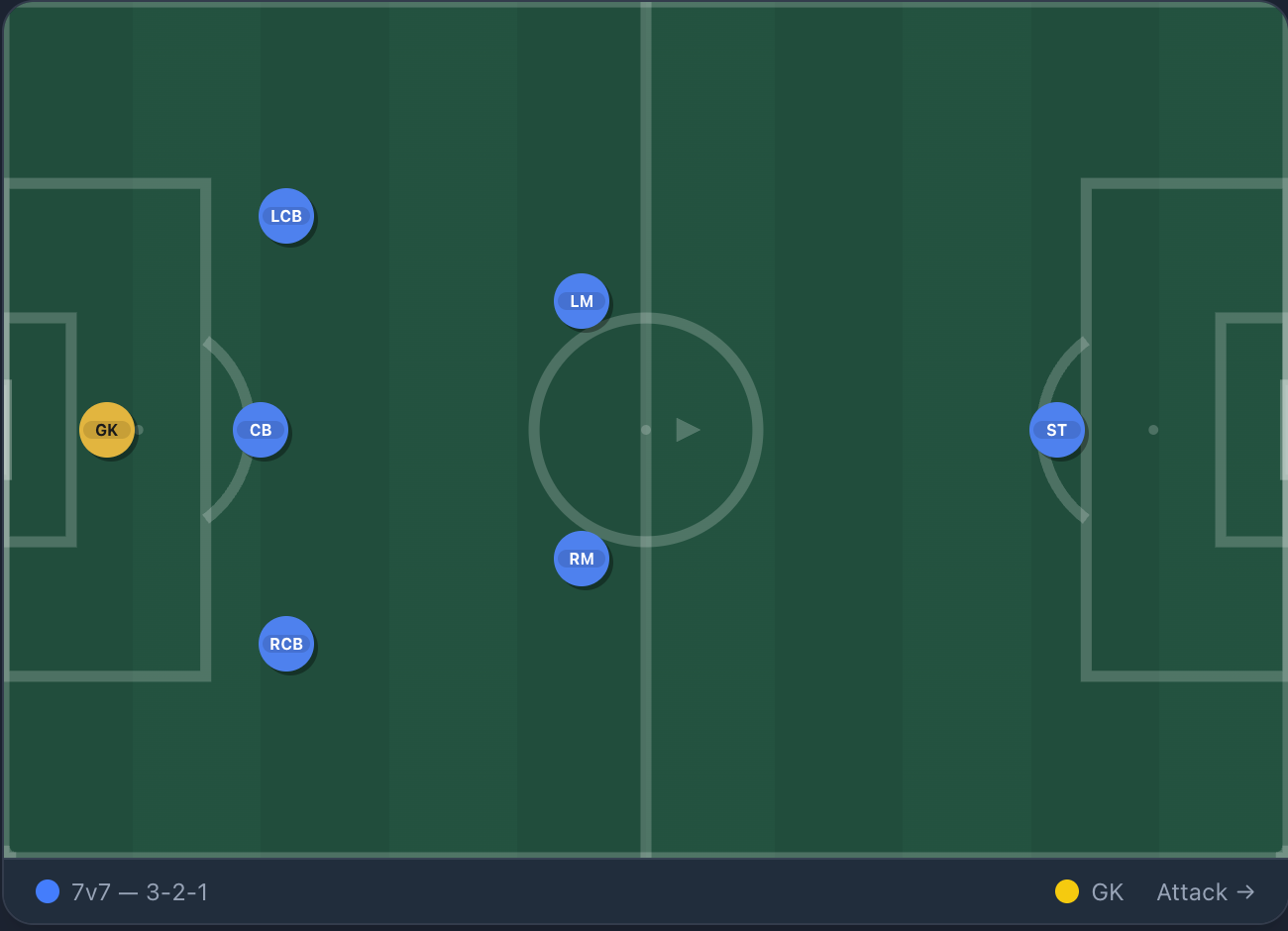
3-2-1: The Build Shape
3-2-1 shifts the weight backward. Three at the back creates a platform, which works well when you want to emphasize your goalkeeper's distribution and build possession from the first line — a deliberate choice if you're prioritizing game understanding through the ball-playing end of the pitch.
Here's what it develops that 2-3-1 doesn't: your three defenders are regularly in situations where they must receive under pressure, make decisions, and connect with the midfield pair above them. That's ball mastery in a high-consequence context — not a rondo where nothing is at stake, but a real defensive moment where a poor touch or a slow decision has immediate consequences. For players who are naturally defensive-minded, this shape gives them the touch volume and the decision-making repetitions they need.
The two midfielders will work harder without the extra body in the middle, which is worth knowing. They'll be asked to cover more ground and make more individual decisions per minute. That can be a feature rather than a bug — but calibrate it to who you have. A pair of high-motor players in midfield will thrive. A pair who are still finding their confidence might get swallowed.
Understanding space is where 3-2-1 earns its reputation. Because the shape loads the back half, the spaces between the lines become wider and more obvious. Your midfielders have to see them and run into them. Your forward has to learn to move into space rather than come toward the ball. That's a genuinely hard concept at U9 — and the 3-2-1 creates the situation that teaches it repeatedly.
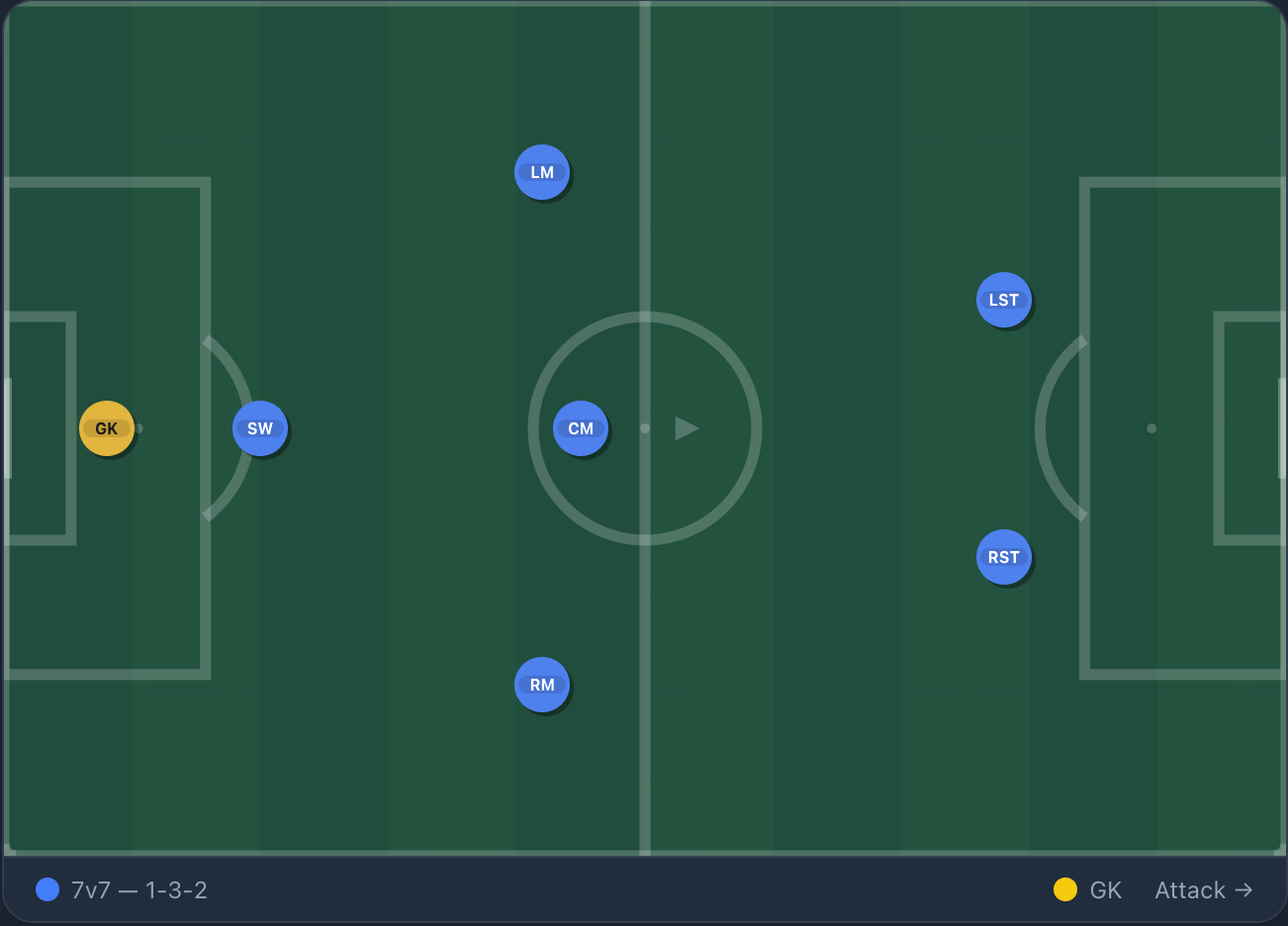
1-3-2: The Attack Shape
1-3-2 flips the emphasis toward the forward third, with a single defender behind three midfielders and two forwards. This is the highest-risk starting reference of the three — and also the one with the most raw development packed into it, if you can tolerate what it looks like.
Two forwards mean constant 2v1 and 2v2 situations in the attacking half. For developing ball mastery and combination play — for teaching players to combine rather than hoard — this is one of the most productive environments you can create. Your two forwards are forced into small-space solutions: wall passes, overlaps, back-heel turns, quick combinations under defensive pressure. They get uncomfortable. They figure things out. That's the job.
The three midfielders are in a genuinely difficult situation. With only one defender and a goalkeeper behind them, there's no safety net. A midfielder who loses the ball must sprint to cover — which means that transition moment, the shift from attacking to defending, becomes a high-frequency learning event. Your players will feel the consequence of losing the ball. They'll learn to value possession not because you told them to but because the shape teaches the lesson through experience.
The tradeoff is clear: your goalkeeper will be tested, and your single defender will face 1v2 situations regularly. If that's where you want the learning to happen — in high-pressure, recover-and-defend situations — there's nothing wrong with it. If you have a goalkeeper who is still building confidence, consider whether that exposure helps or hurts right now.
All three are legitimate starting references. None of them should become a positional discipline system.
Every player in your care is someone's most important person. CORE gives you the structure to honor that — consistently, personally, and with the long view. Take the 15-minute Assessment at corecoaching.soccer →
Teaching Through the Four Moments
Once you've chosen a shape, the most powerful thing you can do is stop talking about the shape and start talking about the game. Specifically: the four moments. In possession. Out of possession. Attacking transition. Defending transition.
These four moments give your players a vocabulary for reading what's happening around them. Instead of "go back to your position," you ask: "We just lost the ball — what moment are we in? What's your job now?" The shape doesn't answer that question. The moment does. And a player who understands moments doesn't need to be told where to stand — they figure it out from what the game is showing them.
Picture the 22nd minute of a U9 game. One of your players has the ball at his feet, a defender closing fast, two teammates making runs he hasn't seen yet. The moment is alive with possibility. Real decision-making, real consequence, real learning.
Then you call out from the touchline: "Get back in your shape!"
He hears you. He stops processing the game. He starts processing your instruction. The moment passes.
That interruption — repeated across a season, across years — is how we accidentally train players to look at the sideline instead of at the game. We teach them to wait for information rather than generate it. The four-moments framework is the alternative: it gives players a mental model they can run on their own, without you.
In practice, use the moments as the language of every stoppage. Not "why weren't you in position?" but "what moment was that? What did we need to do?" Quick, specific, game-connected. Let the answer come from them.
How to Get Shape Without Teaching Shape
Here's the real coaching unlock at this age: the most durable positional sense doesn't come from drilling formation — it comes from constrained small-sided games that make good positioning the natural solution.
A winger who keeps drifting central isn't disobedient. She hasn't yet felt what width unlocks. Design the environment so she discovers it.
Four-goal games — two small goals on each end line — force players to constantly think about where they are on the pitch. To score, you need width. To defend, you need to cover multiple angles. The shape emerges from the problem, not from instruction.
Wide-zone games — a pitch divided so that scoring requires using a wide area — make the wide midfielder's role self-explanatory. You don't need to tell your player to hold width. The game tells her. Every time she drifts inside and the team can't access the wide zone, she feels the consequence. Every time she holds wide and creates an outlet, she feels the reward.
Five-lanes / three-thirds games — a spatial grid overlaid on the pitch — introduce the concept that the pitch has zones and that different zones carry different responsibilities. Your players start to develop an internal map of the game: "I'm in the middle third, in the centre lane — my job right now is to connect." That map is what formation actually is when it works.
The key is sequence. Use these constrained games before you talk about a specific 7v7 formation. Let your players feel the spatial principles first — why width matters, why the middle third is contested, why transition speed matters — and then name the formation as a starting reference that organizes those principles. In that order, formation makes sense. The other way around, it's just a diagram.
Formation as Identity, Not Instruction
Here's a reframe worth sitting with. When a player begins to feel what it means to be a central midfielder — to be the connector, the one who links defence and attack — they're not learning a position. They're discovering a piece of who they are on a football pitch.
That's what's actually at stake in how you teach 7v7 formation. A child who leaves a session saying "I'm the one who links the back and the front" carries something far more powerful than a child who can recite a 3-2-1 structure. One has information. The other has identity. Information fades. Identity compounds.
This is the longer project underneath the formation question. You're not just distributing players across a pitch. You're helping ten-year-olds begin to answer the question: who am I in this game? That answer will evolve for years. But the first real version of it often forms in the 7v7 window — which means how you teach shape at this age shapes more than shape.
Your coaching identity is what holds this steady when the scoreline is against you, when the game looks chaotic, when a parent wonders why you're not drilling a tighter structure. A coach whose sense of purpose is rooted in developmental clarity — I know what these players need at this age, and I know which shape serves it — coaches with more authority than one who's just running the most familiar formation. The shape should come from your understanding of your players. That understanding comes from knowing who you are as a coach.
The Coach Who Trusts the Game
Back to that opening image. Your U9s, thirty seconds in, completely scattered.
Maybe that's not failure. Maybe that's six children making decisions at high speed, chasing a ball, figuring out the game by playing it. Maybe the one who's frozen on the touchline needs you to call not her position, but her name — to remind her that she belongs in this, that the game is hers to figure out.
The formation you choose will fade within moments of kickoff. What lasts — what actually accumulates across a Foundation career into something real — is the quality of 1v1 repetitions, the emotional safety to try things and fail, and the growing sense that the game makes sense and that they, specifically, are good at it.
So choose a shape that serves your developmental priorities. Use the 2-3-1 if you want to flood the middle and create 1v1 volume. Use the 3-2-1 if you want to build from the back and teach players to see the spaces between the lines. Use the 1-3-2 if you want high-frequency combination play and transition pressure. Each one is a tool. None of them is a destination.
The shape you use matters less than what you do when it falls apart. And at U8–U10, it will always fall apart. Your job isn't to stop that. Your job is to make sure that when it does, your players are engaged, confident, and chasing the ball with joy — not watching the sideline for instructions.
Every player in your care is someone's most important person. CORE gives you the structure to honor that — consistently, personally, and with the long view. Take the 15-minute Assessment at corecoaching.soccer →