It's five minutes before kickoff. You're standing on the outside of the center circle, looking at nine players who are looking back at you. You've written a lineup on your clipboard. You've been coaching 7v7 for three years. This is your first 9v9 season, and you've just realized — standing here, right now — that you have no idea where to put these two extra players.
Every coach who has made the jump to 9v9 has had this moment. The shape that felt natural at 7v7 doesn't stretch cleanly to nine. The 4-3-3 you know from watching the Premier League doesn't fit the field. You're reaching for something and coming up empty.
This article gives you a formation-by-formation breakdown — the pros, the cons, the player profiles each shape demands, and the tactical coaching points that unlock it. Plus a clear recommendation if you coach pressing, possession, or counter-attacking football.
There is no objectively best 9v9 formation. But that does not mean all formations are equal for you, with these players, playing this way. The coaches who get the most out of their shape are the ones who matched formation to coaching identity AND player reality — not the ones who found the theoretically optimal system. Identity precedes system. Always.
What 9v9 Actually Is
9v9 is not a scaled-down version of 11v11. It is its own format, with its own spatial logic and its own developmental purpose. The pitch is bigger than 7v7 but smaller than 11v11, and the relationships between players multiply significantly when you add two more bodies. Players who have spent years in 7v7 now encounter a game where positioning matters more and where where to be when you don't have the ball becomes a genuine tactical question for the first time.
Coach it on its own terms. The decisions your players make here — how to transition, how to find width, how to press as a unit — are not rehearsals for a future game. This is the game. Right now.
The best in-game decisions come from coaches who prepared so thoroughly that their identity shows up automatically under pressure. Take the 15-minute Assessment at corecoaching.soccer →
The Four Common 9v9 Formations
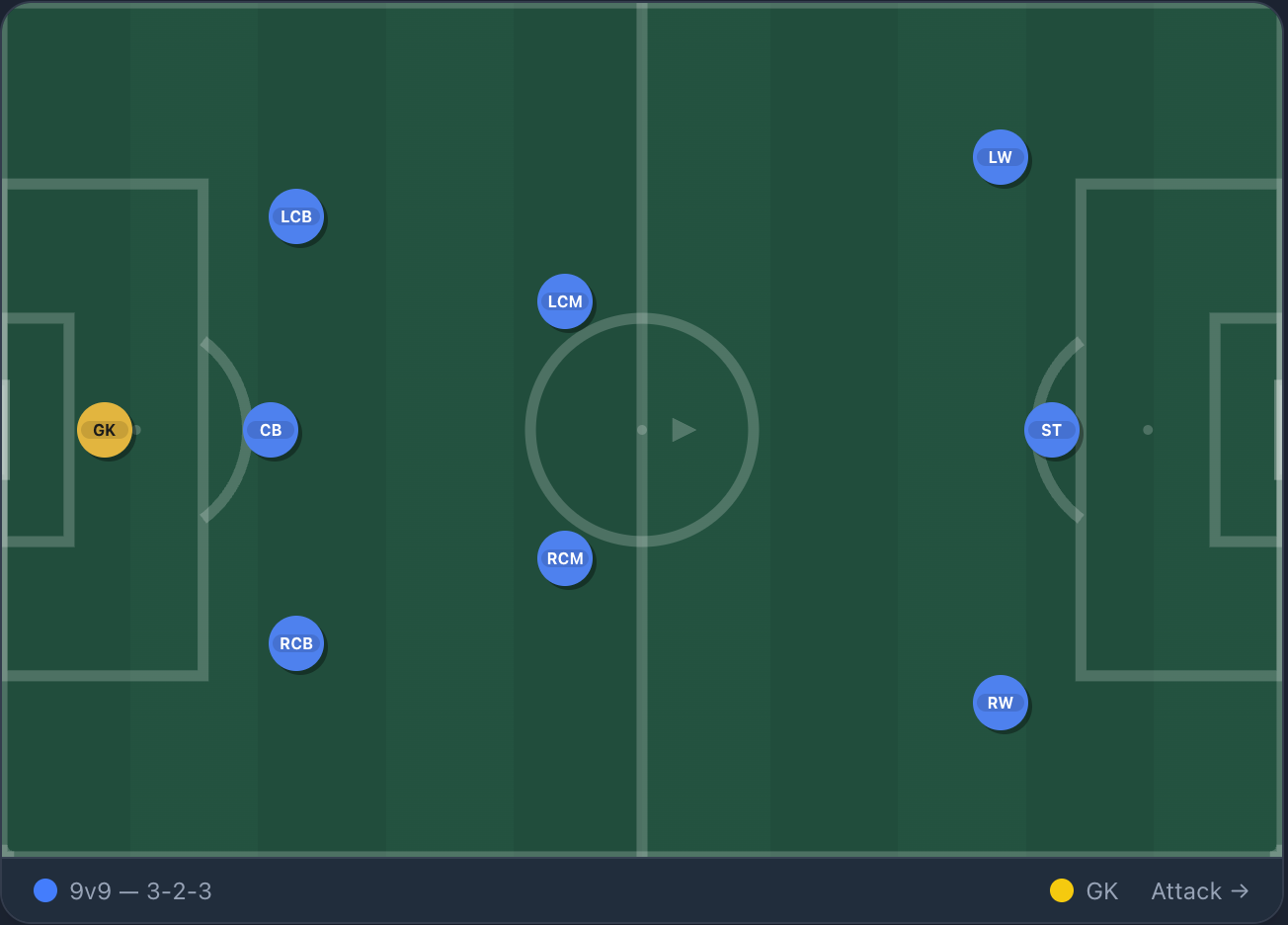
3-2-3: The Developmental Standard
The shape: Three defenders. Two central midfielders. Three forwards.
Why it works at 9v9: The 3-2-3 is the only formation built specifically for this format. Its structure makes the game's problems visible — width, spacing, line connections — in a way that teaches the game while you play it. Three forwards create natural width without coaching. The double pivot in midfield introduces the concept of coverage and connection at exactly the age players can begin internalizing it. Three defenders give you a clean triangle to build from.
Pros:
Natural width without constant coaching prompts
The double pivot teaches positional responsibility early
Builds cleanly from the back through clear triangles
Maps directly onto Foundation and Youth LTAD priorities
Makes all four moments of the game learnable within the same structure
Cons:
Two midfielders carry a heavy workload — if they're weak, the whole shape suffers
Outer defenders must be comfortable receiving and playing under pressure
Requires patience; coaches who want to go direct will fight this shape every week
Player profiles that fit:
Outer defenders who can receive facing outward and play simple combinations under pressure
Central midfielders who understand when to cover defensively and when to connect forward — ideally one who breaks forward and one who holds
Wide forwards who stay disciplined in their lanes and understand when to combine vs. when to hold width
Tactical coaching points:
Build through your back three to the double pivot: goalkeeper finds a wide defender, who connects to the nearest midfielder
The two midfielders should almost never both be in the same horizontal line — one steps, one covers
Forwards hold width until the ball arrives in the final third; they do not centralize early
Use the five-lanes / three-thirds framework to give players a spatial mental model for their starting positions
When the press is on: the ball-near midfielder drops as an outlet; the ball-far midfielder shifts into a central covering position
Best for: Coaches who believe in building from the back, want to teach positional play, and are comfortable letting the game develop rather than forcing it long. If you identify as a Builder or Architect in your attacking philosophy, this is likely your formation.
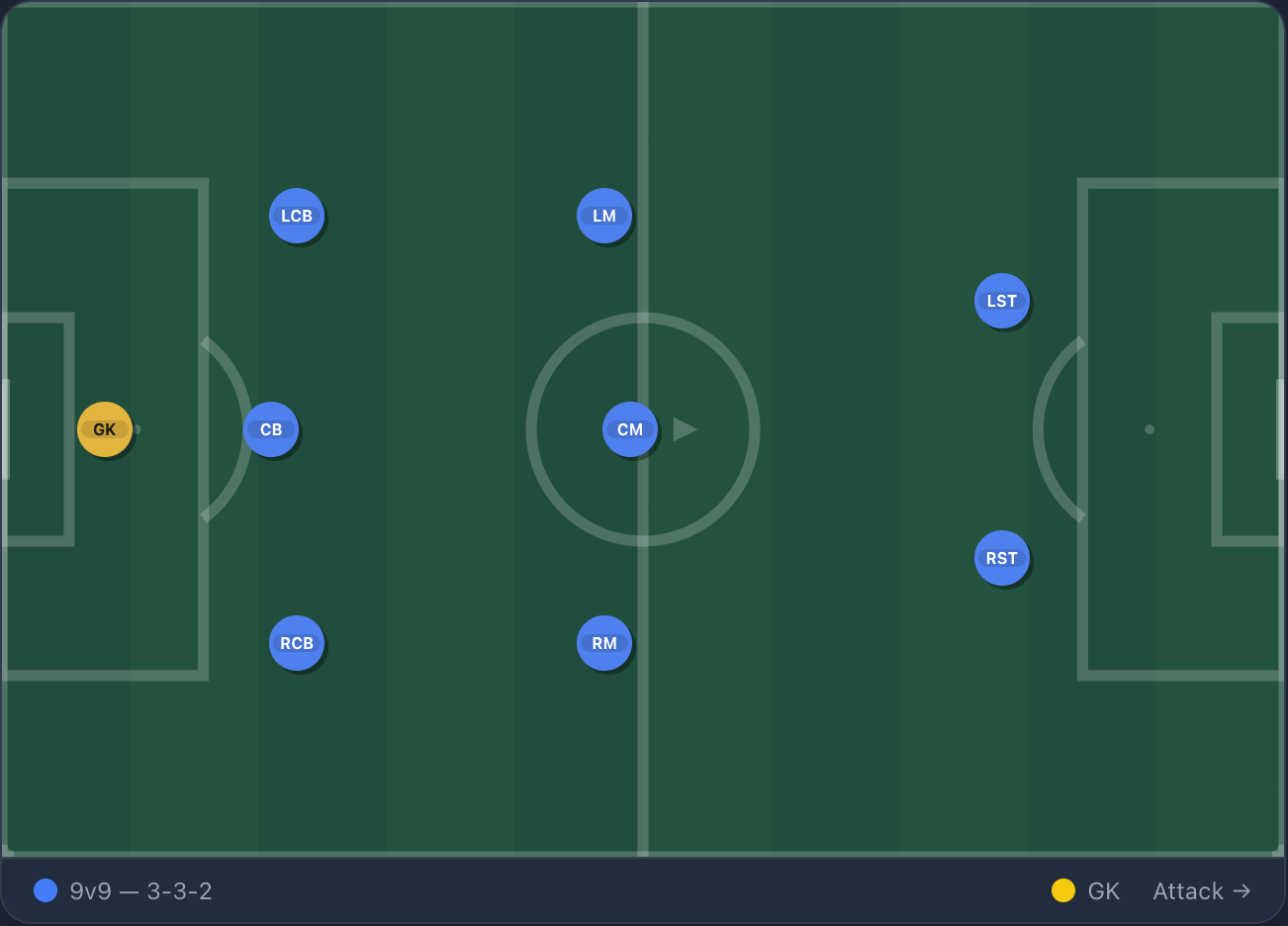
3-3-2: The Compact Control Shape
The shape: Three defenders. Three midfielders. Two forwards.
Why it works: Trading a forward for a midfielder gives you numerical dominance in the zone where most 9v9 games are decided. Your three-person midfield creates coverage angles that the double pivot can't match, and pressing from the middle third becomes significantly more achievable.
Pros:
Midfield control — you outnumber most opponents through the center
Compactness between the lines makes you hard to play through
Middle-third pressing is structurally supported; you have bodies there
Transition pressure is immediate when you win the ball centrally
Cons:
Two forwards rarely stretch a back three wide — you lose natural width
Wide midfielders must make aggressive forward runs to create crossing opportunities, which requires timing and coordination
If your midfield three compresses centrally, the shape becomes narrow and predictable in attack
Player profiles that fit:
Three midfielders with different profiles: one holder, one runner, one connector. A uniform three will either be too passive or too aggressive.
Two forwards who are intelligent movers — they need to create space for themselves without wide support arriving immediately. Runners and combiners both work; pure wide players do not.
Wide defenders who are comfortable stepping forward to provide width when the ball is on their side
Tactical coaching points:
Organize your midfield vertically, not horizontally: one sits, one goes, one connects — not all three at the same depth
When you win the ball centrally, your wide midfielder on the far side should already be running — that is your outlet before the opposition recovers
Press in a mid-block shape: front two hold, middle three compress, defenders hold the line — not a high press
Switch play through your midfield to drag the opposition before attacking
In possession, the ball-near wide midfielder overlaps; the ball-far wide midfielder holds width as the safety valve
Best for: Coaches whose instinct is to control the game through the center and build pressure in the middle third. If your natural animation is midfield compactness and transition pressure — if you want to win the ball high through collective pressing rather than individual duels — the 3-3-2 rewards that identity.
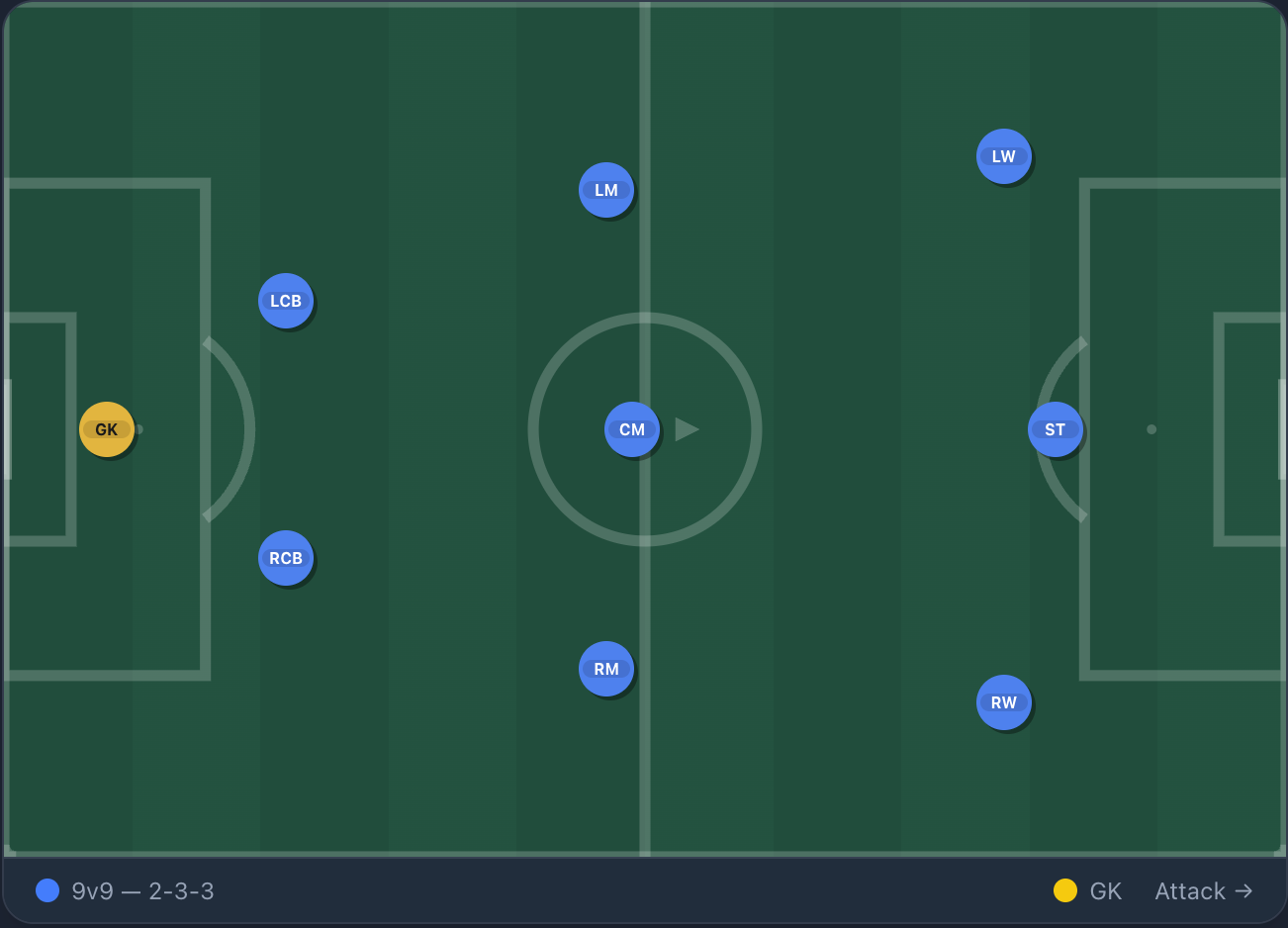
2-3-3: The High-Press Shape
The shape: Two defenders. Three midfielders. Three forwards.
Why it works: The 2-3-3 is a declaration. Two defenders behind you tells your team exactly what you expect: we press from the front, we win the ball in their half, and we play at speed. When it works, it is genuinely beautiful — relentless, direct, and hard to play against.
Pros:
Maximum forward presence — six outfield players in or near the opposition's half
High press is structurally supported; your three forwards can pin back the entire opposition backline
Transition speed is exceptional — when you win it high, you are already in a shooting position
Creates chaos that less organized teams cannot handle
Cons:
Two defenders are badly exposed when the press breaks down — and at youth level, it will break down
Requires total collective buy-in; one or two players who don't press kills the entire structure
More coaching attention required than any other formation — you will spend meaningful session time managing defensive discipline
Not recommended for U10–U11 groups new to 9v9; the defensive exposure is developmentally risky
Player profiles that fit:
Two defenders who are athletic, decisive, and mentally tough — they will face 2v1s regularly and need to manage them confidently
Three midfielders who press forward and recover quickly; they are the engine of the shape
Three forwards who understand pressing triggers and press as a coordinated unit, not as individuals chasing the ball
A goalkeeper with exceptional distribution — your first pass out of pressure is from the keeper, and it must be good
Tactical coaching points:
Define your press trigger as a team before you play — a back pass to the goalkeeper, a miscontrol, a slow center back. Everyone presses the same trigger simultaneously.
Your front three press in a unit: near-side forward leads, the other two cut off passing lanes rather than chasing
When the press is beaten, your three midfielders must immediately drop to create a compact 2-3 defensive block
Your wide forwards are not pure attackers — they track wide defenders on their side when out of possession
Drilling transition shape (won → attack fast; lost → recover fast) is not optional at this shape — it is the core session work
Best for: Pressers — coaches who feel most alive when their team wins the ball in dangerous areas and plays at speed. If the 3-2-3 feels too conservative and you want your forwards pressing the goalkeeper directly, this is your shape. Know going in: the 2-3-3 requires more coaching investment than anything else on this list.
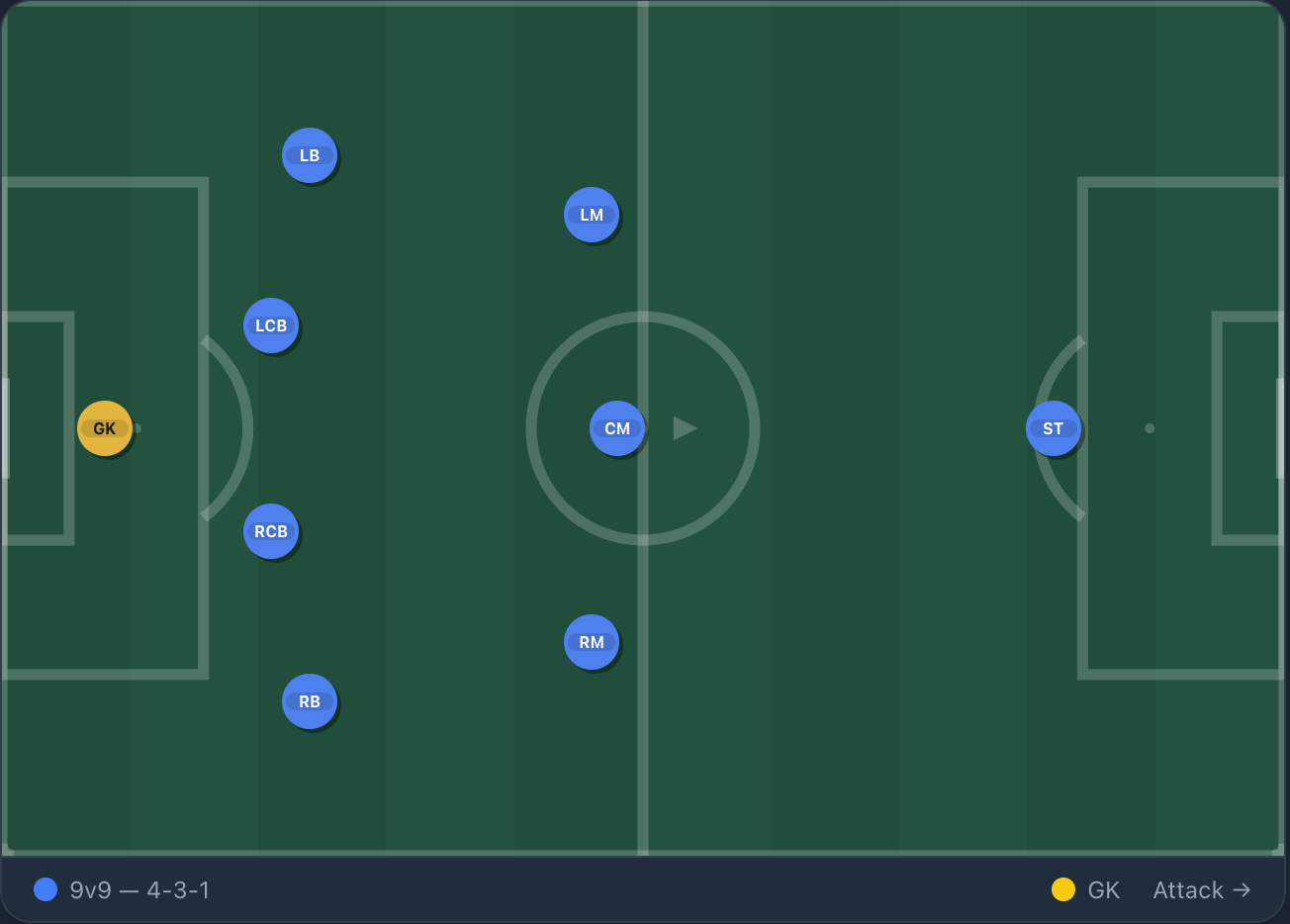
4-3-1: The Transitional Shape
The shape: Four defenders. Three midfielders. One advanced forward.
Why it works (and when it doesn't): The 4-3-1 is the most 11v11-adjacent of the common 9v9 formations. It introduces a four-person back line, which feels familiar and defensively secure to many coaches making the jump from older formats. When you have the right personnel, it can be a strong shape for counter-attacking play.
Pros:
Defensive security — four defenders give you extra coverage and make you difficult to break down
Three midfielders can dominate the center of the pitch
Suits counter-attacking football: hold shape, win the ball, release quickly to your forward or a late-arriving midfielder
Natural transition into 11v11 defensive structure
Cons:
Demands very specific player profiles — particularly a lone forward who can hold up play and combine intelligently
Without width in attack, you can become narrow and predictable
Four defenders at 9v9 can produce passive defensive behavior — too many players beside each other reduces the urgency to press. For the developmental age this format serves, that is a habit you do not want to reinforce.
A dominant central midfielder functioning as a virtual second forward is a requirement, not a bonus
Player profiles that fit:
One forward with the intelligence to hold up play, link with midfield runners, and make runs in behind selectively — not just sprint forward constantly
A dominant central midfielder who makes forward runs at the right moments, arriving late into the box
Wide midfielders who get forward and provide the width the formation otherwise lacks
Four defenders who understand when to step and when to hold — a flat four that just sits invites pressure
Tactical coaching points:
Your lone forward presses the deepest center back when the opposition has the ball — not both center backs, just one. This shapes the opposition's build-up direction.
The central midfielder's forward run is the primary attacking movement — coach this deliberately and repeatedly
Wide midfielders must overlap aggressively when the ball goes wide; without this, you have no width
Counter-attack trigger: win the ball, find your forward's feet immediately, midfield runners support; do not slow down to recirculate
Use 5v4 zoned build-up games to teach your back four and midfield three how to circulate and break lines
Best for: Coaches who prioritize defensive organization and want to win games on transitions. Works best in competitive contexts where results matter more than development. Less appropriate as a primary developmental shape for new 9v9 players.
Formation Recommendations by Coaching Philosophy
Here are three direct recommendations. Not hedged — direct.
If you coach a pressing style: Start with the 2-3-3. It is built for you. Your job is to define the press trigger clearly, build the collective discipline to execute it consistently, and design sessions around transition shape rather than static positioning. The developmental risk is real — two defenders will get exposed — but if pressing is genuinely your identity, the 3-3-2 will frustrate you within three weeks. Commit to the 2-3-3 and coach the defensive discipline hard.
If you coach a possession style: Start with the 3-2-3. It is the possession coach's natural home at 9v9. The three-defender base gives you a clean build structure. The double pivot creates the central connections possession football lives on. The wide forwards hold width and stretch the opposition. Your coaching work is building out-of-possession shape and teaching your defenders to play through pressure rather than going long.
If you coach a counter-attacking style: Start with the 4-3-1 or the 3-3-2. Both give you defensive structure and a clear transition trigger. The 4-3-1 is more defensively secure but demands a genuine lone forward profile. The 3-3-2 gives you more midfield flexibility and slightly more attacking variety. If you have a forward who can hold up play, go 4-3-1. If you don't, go 3-3-2 and use a striker pair to press and transition together.
How to Choose for Your Specific Team
Beyond coaching identity, two questions cut through the noise.
What do your players actually do well right now? Not what you're developing — what do they do organically when the game is just played? Do they press naturally? Do they find each other in tight spaces? Start there. The best formation for your team right now lets their existing strengths be expressed while asking them to stretch in one clear direction.
Where is this team in its 9v9 journey? For most U11–U12 groups arriving at 9v9 for the first time, the 3-2-3 is the right entry point — not because it is superior, but because its structure makes the game's problems visible. It teaches width and shape organically. It develops the players even when the result doesn't go your way. If your group has a year of 9v9 under them and you are ready to specialize, that is when you adapt toward the shape that fits your identity.
Before Your Next Game
Stand on that touchline again. Same nine players, same clipboard. Before you write a formation down, answer two questions honestly: What do my players genuinely do well right now? And what kind of game do I actually want to play — not theoretically, but when the pressure is on and my instincts take over?
The formation that answers both of those questions is your formation. Not forever — it will evolve as your players grow and as you grow — but for now, for this team, at this moment.
Formation guides can give you structure. Only you know which structure you can actually coach.
The best in-game decisions come from coaches who prepared so thoroughly that their identity shows up automatically under pressure. Take the 15-minute Assessment at corecoaching.soccer →