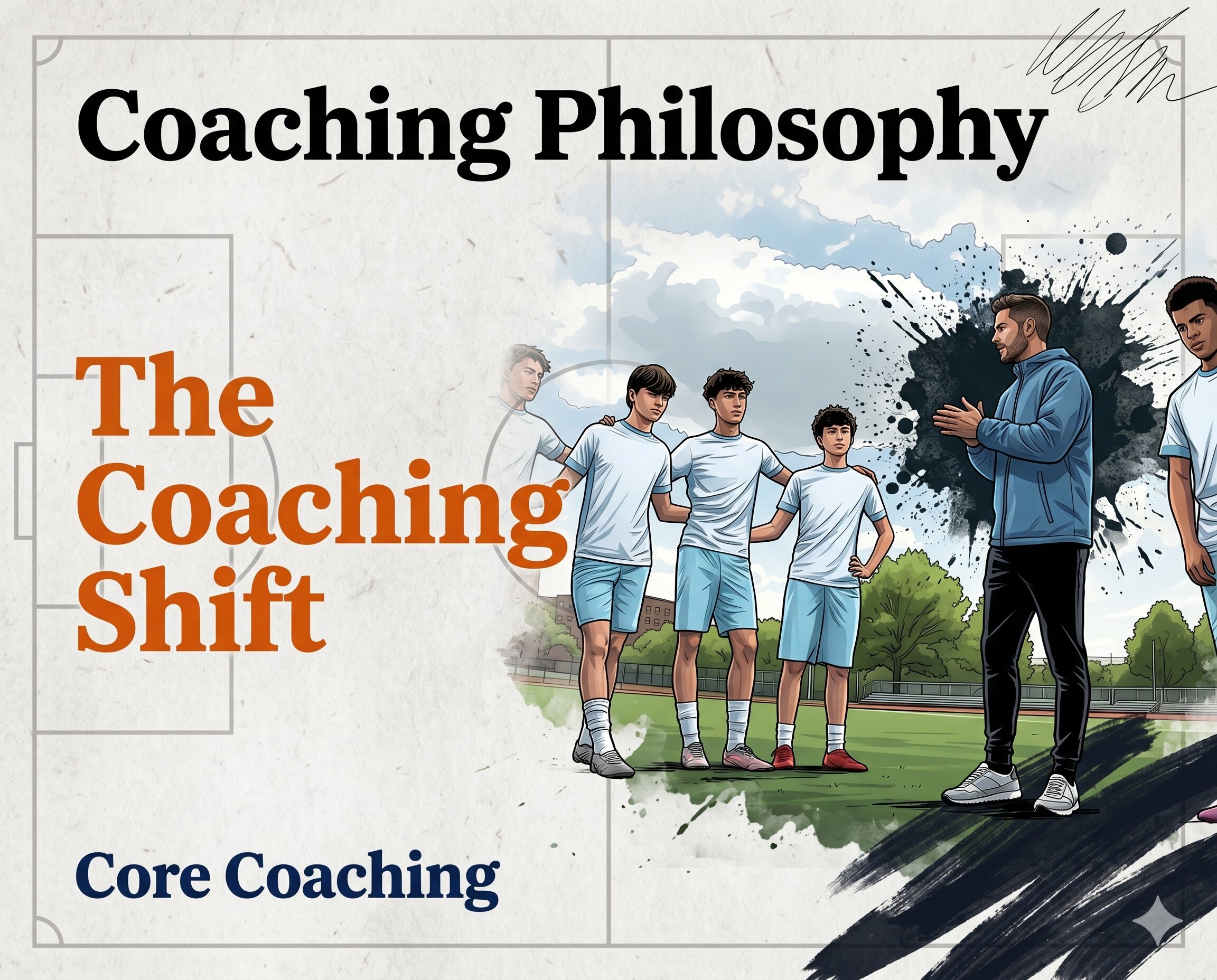
It's the 68th minute. You're down one. Your midfielder just gave the ball away for the third time in the same channel — the same one you spent forty minutes on Thursday closing down. You hear yourself before you even feel it: "What are you doing? We worked on that!" The words are out. The tone is out. You watch the kid's shoulders drop.
You are not a screamer. You know that. You've told people that. And yet here you are.
This is the moment most coaching development content skips past. It treats the gap between the coach you plan to be and the coach who actually shows up on matchday as a discipline problem — a matter of self-control, of willpower, of trying harder to hold it together. But the gap isn't a discipline problem. The Coaching Shift is an identity problem. And willpower alone will never close it.
The Two Coaches Inside You
Every coach has two versions of themselves.
The first one lives in your office, your car, your notes app at 11pm. This coach is thoughtful. This coach has a philosophy. This coach plans sessions with purpose, thinks carefully about what players need, and can articulate clearly — if someone asked — what kind of environment they want to create. Call this one the Office Coach.
The second one shows up at kickoff. This coach operates in real time: loud, fast, unpredictable, emotionally charged. The scoreboard is moving. A parent is pacing. Your center back is playing like it's her first session. This coach responds to all of it — sometimes beautifully, sometimes in ways the Office Coach would barely recognize. Call this one the Sideline Coach.
The Coaching Shift is the distance between them.
Here is the part that should sit with you: your players experience almost exclusively the Sideline Coach. The planning, the reflection, the care you put into Thursday's session design — none of it is visible to them on Saturday. What they see, what they feel, what they carry home is the coach who showed up when it mattered. And if those two versions of you are strangers to each other, your players experience that strangeness as inconsistency. As unpredictability. As a signal that they can't quite trust what they're going to get.
What Triggers the Shift
The Coaching Shift isn't random. Three forces reliably pull even the most self-aware coaches away from who they intend to be.
Adrenaline. The physiological response to competition — elevated heart rate, cortisol, narrowed attention — is not a character flaw. It's biology. Your body reads the match environment as high stakes, and it responds accordingly. Without a developed capacity for self-regulation, that adrenaline produces urgency behaviors: instruction overload, raised voice, shortened feedback loops. You stop watching the game and start reacting to it. The ability to hold a stable emotional register regardless of scoreline — what we call Emotional Constancy — is one of the clearest markers of a coach whose identity is doing the work.
The scoreboard. This one is harder to admit. When your team is losing, the number on the board doesn't just track the game — it threatens your sense of competence. Your professional worth feels implicated. And so you intervene more, control more, substitute patience for urgency. You shift from development-first to result-first not because you changed your values, but because your nervous system momentarily hijacked them. The scoreboard effect is one of the most reliable triggers of the Coaching Shift, and it operates almost entirely below conscious awareness.
External pressure. A director watching from the bleachers. A parent who emails after every game. A peer you respect standing near the touchline. The presence of evaluative eyes activates performance anxiety — and performance anxiety changes behavior in a specific, predictable direction: more directive, more conservative, less willing to let mistakes happen. Which is, almost always, the exact opposite of what your philosophy calls for. Under scrutiny, coaches default to their comfort pole rather than the intentional position they've worked to build.
None of these triggers mean you're coaching wrong. They mean you're coaching under conditions that will reliably reveal the gap between your Office Coach and your Sideline Coach. The question isn't whether the gap exists — it does, for every coach at every level. The question is how wide it is and whether you're doing anything about it.
What Your Players Are Actually Receiving
The Coaching Shift isn't just a coach development problem. It is a player experience problem.
When the Sideline Coach diverges sharply from the Office Coach, your players experience a version of you they cannot predict and cannot fully trust. A coach who is warm, developmental, and encouraging on Tuesday but controlling and anxious on Saturday sends a mixed signal — and players, especially developing ones, read the sideline version as the truth. They discount the Tuesday version because Saturday feels more real.
The research on the Pygmalion Effect is clear: coaches who hold high, stable belief in their players — and communicate it consistently — produce measurably better development outcomes. But belief communicated during the week and anxiety communicated during the match creates cognitive dissonance. Players feel the contradiction even when they can't name it.
This is why the tools matter less than the operating system running them. Positive Framing and Precise Praise are techniques that narrow under pressure — not because you forgot them, but because your bandwidth for accessing them compresses when the Sideline Coach takes over. Pedagogy and identity cannot be separated. Your self-regulation capacity is the operating system that everything else runs on.
Most platforms start with what you do. CORE starts with who you are. Take the 15-minute Assessment at corecoaching.soccer →
Identity Clarity Is Not the Same as Trying Harder
When coaches first encounter the Coaching Shift, the instinct is to respond with effort. I'll be more intentional. I'll write my values on my clipboard. I'll breathe before I respond. These are not bad ideas. But they treat a structural problem like a behavioral one, and behavioral fixes dissolve under enough pressure.
Identity-First Coaching begins with a different premise: sustainable, effective coaching starts not with better habits but with a clear, examined answer to who you are as a coach. Identity clarity doesn't prevent the Coaching Shift entirely — the triggers are physiological and environmental, not just cognitive. What it does is reduce the gap by giving you a stable reference point to return to. When the adrenaline hits and the scoreboard moves and the parent starts pacing, a coach who has done the identity work has something to anchor to. The Sideline Coach still shows up. But it sounds more like the Office Coach than it used to.
That clarity lives in your Coaching Philosophy — the articulated beliefs, values, and principles that define how you want to operate. But articulation alone isn't enough. A philosophy written in a notebook and never tested is just good intentions. Identity has to be pressure-tested to become functional.
Seeing Yourself Accurately
The hardest part of this work is not the reflection. It's the accuracy.
Most coaches assess themselves by their intentions, not their impact. You know what you meant to communicate on Saturday. You know what you were trying to do. But your players only have access to what you actually did. The Coach Philosophy Assessment exists precisely to surface the gap between those two things — to create the conditions for a coach to see themselves with more honesty.
360-Degree Feedback extends that diagnostic further, bringing in the perceptions of players, parents, and peers to triangulate the distance between how you believe you show up and how you are actually experienced. This is where the most productive discomfort tends to live. Not because the feedback is harsh, but because it is specific. You stop theorizing about your gap and start seeing it.
And seeing it is the beginning of closing it — not through willpower, but through identity work. Through the slow, deliberate process of building a Sideline Coach whose default behaviors more closely match the coach you've chosen to be.
The Pillar That Makes the Others Work
Leading Yourself is the foundational pillar of the CORE framework for a precise reason: you cannot lead players you haven't learned to lead yourself first.
Tactics, session design, game management — these are downstream competencies. They matter enormously. But they run on an operating system, and that operating system is you. A coach who has done the Leading Yourself work brings those tools to the sideline with consistency. A coach who hasn't will find that the best session plan in the world meets a version of themselves on matchday that the plan never accounted for.
The Coaching Shift will keep happening. The triggers are real. The environment is genuinely difficult. But every time you feel the gap — every time you hear yourself and think that wasn't me — that moment is information. It tells you exactly where your identity work needs to go next.
The coach who takes that seriously doesn't become a different person. They become a more complete version of who they already are.
The Coach You're Becoming
Go back to the 68th minute. The midfielder's shoulders dropped. You heard yourself.
Here is what the best version of that moment looks like — not perfect, not silent, but intentional. A coach whose identity is doing the work doesn't eliminate the tension. They feel it and respond from somewhere more stable. Not because they tried harder in that moment, but because they did the work long before kickoff. They know who they are when the environment cooperates. And increasingly, they know who they are when it doesn't.
That's not a discipline upgrade. That's an identity shift. And it is available to you — not through the next session plan, but through the clearest possible answer to the question you started coaching to answer: Who am I, and what does this game ask of me?
The gap between your Office Coach and your Sideline Coach is not a character flaw. It is an invitation. Where are you going to start?
Most platforms start with what you do. CORE starts with who you are. Take the 15-minute Assessment at corecoaching.soccer →